 Domino Score
Mexican Train
Mexican Train Dominoes Rules and Scoring (with Examples)
Mexican Train rules from setup to the last round: the hub, private trains, markers, doubles, 13 rounds from 12 to 0, and how to score, with examples.
Mexican Train is the domino game that gets a whole table playing at once. Up to eight people build trains out from a central double, race to empty their hands, and count what is left after every round. Points count against you, so after the last round the player with the lowest total wins. This guide covers the full rules, from setting up the hub to the final score sheet, with a free printable sheet at the end.
New to dominoes altogether? Start with how to play dominoes; this guide assumes you know how matching tiles works.
What you need
Mexican Train is played with a double-twelve set: 91 tiles, numbered 0 to 12 on each half, worth 1,092 pips in all. You also need:
- A marker for each player, plus one for the Mexican Train. Many sets come with little plastic trains; coins work just as well.
- A hub (also called a station or centerpiece), optional. It holds the starting double in the middle and has a slot for each train. Without one, just lay the double in the middle of the table.
- A score sheet. Ours is free to print, further down.
Setup and the deal
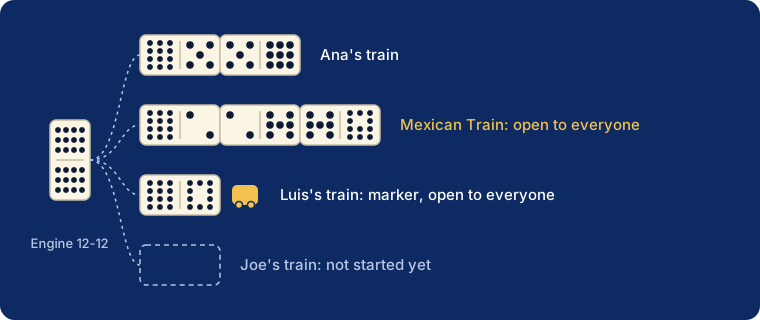
Pull out the double for the round (the 12-12 in round 1) and put it in the hub or the middle of the table. This double is the engine. Turn the remaining tiles face down and shuffle them. Each player then draws a hand:
| Players | Tiles each |
|---|---|
| 2 to 4 | 15 |
| 5 to 6 | 12 |
| 7 to 8 | 10 (some rule sheets say 11) |
The tiles that aren't dealt stay face down as the boneyard. Players stand their tiles on edge and usually sort them into a planned train before play starts.
The trains
There are two kinds of train, and both start with a tile that matches the engine.
- Your own train. Each player has a private train running out from the engine toward their seat. Normally only you may play on it.
- The Mexican Train. A shared train that anyone may start and anyone may add to. Its marker sits on it all round so everyone knows it is open.
Playing a round
The player to the left of the dealer usually goes first, and play moves clockwise. Rule sheets differ on the first turn: in one popular version, each player on their first turn lays down as many tiles as they can in a line on their own train, and nobody may start the Mexican Train on that turn. In others, everyone plays one tile per turn from the start. Agree which you play.
After that, on your turn you play one tile on one of these:
- Your own train.
- The Mexican Train (or start it, with a tile that matches the engine).
- Any other player's train that has a marker on it.
If you can't play, draw one tile from the boneyard. If it fits, play it. If it doesn't, you pass and put your marker on your own train.
Markers: when your train is open
A marker on your train means anyone may play on it. It is the price of being stuck. The marker comes off when you play a tile on your own train again. Some tables remove it as soon as anyone plays on it; agree before the game.
Markers matter for strategy. A player who keeps a clean train with no marker controls exactly which numbers end up at its tip, while an open train is everyone's dumping ground.
Doubles must be covered
A double is laid crosswise, and it must be covered (also called satisfied or closed) by a matching tile before play can go anywhere else.
- When you play a double, you play again right away, and most rule sheets want that tile on the double. (A few let it go anywhere, leaving the double for the next player.)
- If you can't cover it, draw one tile. If that tile covers it, play it. If not, put your marker on your train and pass.
- The next player must then cover the double, even if it is on someone else's private train. If they can't, they draw, mark their own train and pass, and the job moves on around the table.
- Nobody plays anywhere else until the double is covered.
Some groups drop the cover rule entirely or let you go out on a double that nobody has covered. Both are house rules to settle in advance.
How a round ends
A round ends in one of two ways:
- Someone goes out by playing their last tile. Many tables ask you to say so, or tap the table, when you are down to one tile, with a penalty draw if you forget.
- The round is blocked: the boneyard is empty and nobody can play.
Rounds count down from the double 12
A full game has 13 rounds. Each round starts from a different engine: round 1 from the double 12, round 2 from the double 11, and so on down to the double blank in round 13. The player who went out, or the next player around, usually starts the next round.
| Round | Engine | Round | Engine |
|---|---|---|---|
| 1 | 12-12 | 8 | 5-5 |
| 2 | 11-11 | 9 | 4-4 |
| 3 | 10-10 | 10 | 3-3 |
| 4 | 9-9 | 11 | 2-2 |
| 5 | 8-8 | 12 | 1-1 |
| 6 | 7-7 | 13 | 0-0 |
| 7 | 6-6 |
The count-down is also a built-in clock: you always know how much of the game is left.
How scoring works
However the round ended, every player turns over the tiles left in their hand and adds up the pips. That number goes on the score sheet next to their name. The player who went out scores 0 for the round.
Here is the end of round 3 for four players:
| Player | Tiles left | Points this round |
|---|---|---|
| Ana | 4-2, 1-0 | 7 |
| Luis | 12-9, 5-0 | 26 |
| Carmen | none (went out) | 0 |
| Joe | 8-3, 2-2 | 15 |
Nobody "wins" the round as such. Carmen simply had the best possible round, and Luis, caught with the 12-9, had the worst.
The double blank: 0 or 50?
By pip count the double blank is worth 0, which makes it the best tile to be stuck with. Many groups don't like that, so a popular house rule makes the double blank worth 50 points when it is left in a hand. It turns a harmless tile into the most dangerous one and makes players get rid of it early.
Say Joe's hand at the end of a round is 0-0 and 6-1:
| Rule | 0-0 | 6-1 | Joe's points |
|---|---|---|---|
| Standard | 0 | 7 | 7 |
| Double blank counts 50 | 50 | 7 | 57 |
Choose before the game starts. In Domino Score it's the "Double blank counts 50" switch when you set up a Mexican Train game.
A full score sheet
The running total is what matters. Here is a game after six rounds, the same one shown in the app's score sheet:
| Round | Engine | Ana | Luis | Carmen | Joe |
|---|---|---|---|---|---|
| 1 | 12 | 0 | 23 | 41 | 12 |
| 2 | 11 | 18 | 0 | 9 | 33 |
| 3 | 10 | 7 | 26 | 0 | 15 |
| 4 | 9 | 31 | 12 | 22 | 0 |
| 5 | 8 | 0 | 19 | 8 | 27 |
| 6 | 7 | 14 | 0 | 36 | 11 |
| Total | 70 | 80 | 116 | 98 |
Ana leads with 70 after six rounds, but seven rounds are left and one bad round can swing 40 or 50 points. After round 13, the lowest total wins. If two players tie for the lowest total, most groups call it a shared win; some break the tie by who went out in more rounds.
Prefer paper? Print our free sheet. It has columns for up to eight players, a row for every round from the double 12 to the double blank, and a totals line.
Mexican Train score sheet (PDF)Up to 8 players, rounds 12 to 0, totals row. Free to print and share.
Shorter games and other sets
Thirteen rounds can take a whole evening. Common ways to shorten it:
- Play fewer rounds, for example 6 or 7, starting from the double 12 and stopping early.
- Use a smaller set. With a double-nine set the game starts from the double 9 and runs 10 rounds; with a double-six set, 7 rounds.
- Use a bigger set for a big group. A double-fifteen set starts from the double 15 and runs 16 rounds.
Domino Score handles all of these: pick the set (double 6, 9, 12 or 15) and it sets the starting double and the number of rounds to match, which you can then change to anything from 1 to 16.
Chicken Foot is scored exactly the same way, so the same sheet works for it. For games where the hand winner collects the points instead, such as partner dominoes, see how to score dominoes.
FAQ
How many tiles do you get in Mexican Train?
With a double-twelve set, two to four players take 15 tiles each, five or six players take 12, and seven or eight take 10. Some rule sheets give 11 each to seven or eight players.
Can you play on other players' trains?
Only when their train has a marker on it, which means they were stuck on an earlier turn. You can always play on your own train and on the shared Mexican Train.
What happens when you play a double in Mexican Train?
The double has to be covered with a matching tile before anyone plays elsewhere. You get to play again right away; if you can't cover it, you draw, and if you still can't, you mark your train and the next player must cover it.
How many rounds are in Mexican Train?
A full game with a double-twelve set has 13 rounds, one for each double from 12-12 down to 0-0. Many groups play fewer rounds for a shorter game.
Is the double blank worth 50 in Mexican Train?
Only if your group plays that house rule. By pip count it is worth 0, but many tables make it worth 50 when it is left in a player's hand at the end of a round.
Who wins Mexican Train?
The player with the lowest total after the last round. Points are bad in Mexican Train: every pip you are caught holding counts against you.
More domino guides
-
 Dominoes rulesHow to Play Dominoes: Rules for BeginnersHow to play dominoes, step by step: the set, shuffling, the deal, matching tiles, doubles, block vs draw, going out, blocked games and scoring.
-
 Block dominoesBlock Dominoes Rules: How to Play and ScoreBlock dominoes rules: a double-six set, 7 or 5 tiles each, pass when you can't play, and the winner scores the pips left in the other hands. With examples.