 Domino Score
Chicken Foot
Chicken Foot Dominoes Rules: How to Play and Score
How to play Chicken Foot dominoes: the double-nine set, the deal, the starting double, chicken feet on every double, the double blank at 50, and scoring.
Chicken Foot is a relaxed, chatty domino game for a group, and it has the best name in the hobby. Every time someone plays a double, the next three tiles have to fan out from it like the toes of a chicken's foot, and nobody can play anywhere else until the foot is finished. Like Mexican Train, it is a lowest-score game: the tiles left in your hand count against you, round after round, and the lowest total wins.
If you have never played dominoes, read how to play dominoes first. Chicken Foot uses the same matching rules.
What you need
Chicken Foot is usually played with a double-nine set: 55 tiles, 0 to 9 on each half. Two or three players can use a double-six set, and big groups can use a double-twelve. Any number from two up can play, though the game is at its best with four or more. The face-down tiles left after the deal are the boneyard, which some rule sheets call the chicken yard.
The deal
Hand sizes vary more in Chicken Foot than in most games. One widely used rule sheet deals these hands from a double-nine set:
| Players | Tiles each | Left in the boneyard |
|---|---|---|
| 2 | 20 | 15 |
| 3 | 14 | 13 |
| 4 | 11 | 11 |
| 5 | 9 | 10 |
| 6 | 7 | 13 |
Many tables deal smaller hands for a quicker round, for example 12 each for two players, 11 each for three and 10 each for four. Smaller hands mean more drawing; bigger hands mean longer rounds. Either works, so pick one and keep it for the whole game.
Starting a round
The first round starts with the double nine. Whoever holds it plays it in the middle of the table. If nobody has it, everyone draws one tile from the boneyard and checks again, until it turns up.
Each later round starts from the next double down: the double eight in round 2, the double seven in round 3, and so on to the double blank. With a double-nine set that makes ten rounds.
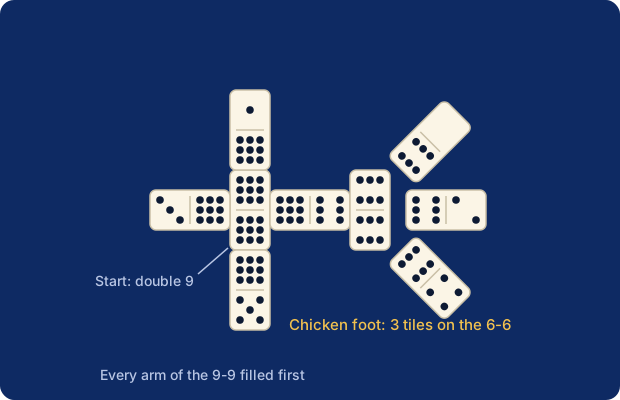
Before any line can grow, the starting double has to be surrounded. In most rule sheets, the next plays go on its four sides, one tile per side, and nobody may add a second tile to any arm until all four are filled. Some tables play a "double chicken foot" instead, with three tiles fanned out on each long side of the starting double, six in all. Agree which one you play.
Playing your turn
Once the starting double is surrounded, play moves around the table. On your turn, add one tile to the open end of any arm, matching numbers as usual. There are no private trains in Chicken Foot: every line belongs to everyone.
If you can't play, draw one tile. If it fits, you may play it right away. If it doesn't, you pass. When the boneyard is empty, a player who can't play simply passes.
The chicken foot rule
Every double is played crosswise, and every double must get a chicken foot: three tiles that match it, fanned out from its far side, before anyone may play anywhere else on the table.
- The player who lays the double often calls "chicken foot" so nobody misses it.
- The next players must play on the double until it has all three toes. A player who can't add a toe draws one tile, plays it if it fits, and otherwise passes. The duty moves on to the next player.
- Once the foot has three toes, play opens up again, and each toe is a new open end.
Doubles are a weapon. Lay one when the other players are short of that number and they will be drawing tiles while you wait.
Ending a round
A round ends when someone plays their last tile, or when the round is blocked: the boneyard is empty and nobody can play. Some tables ask players to warn the others when they are down to their last tile, with a penalty draw for forgetting.
Scoring Chicken Foot
At the end of every round, each player counts the pips on the tiles left in their hand and adds them to their score. The player who went out scores 0. The double blank is worth 50 in most Chicken Foot rule sheets (25 in some), which makes it the tile nobody wants to be caught holding.
Here is the end of round 1 for three players:
| Player | Tiles left | Points this round |
|---|---|---|
| Ana | none (went out) | 0 |
| Ben | 0-0, 9-4 | 50 + 13 = 63 |
| Cara | 5-2, 3-1 | 11 |
Points pile up from round to round:
| Round | Starting double | Ana | Ben | Cara |
|---|---|---|---|---|
| 1 | 9-9 | 0 | 63 | 11 |
| 2 | 8-8 | 17 | 0 | 24 |
| 3 | 7-7 | 8 | 12 | 0 |
| Total | 25 | 75 | 35 |
After round 10, the lowest total wins. Some groups play a different finish: keep playing rounds until someone passes an agreed total, and that player loses while the lowest score wins.
Quick reference
- Set: double nine (double six for 2 or 3 players, double twelve for big groups).
- Rounds: ten, starting from the double nine and counting down to the double blank.
- Start: every side of the starting double gets a tile before any arm grows.
- Doubles: crosswise, then three toes before play goes anywhere else.
- Stuck: draw one tile, play it if it fits, otherwise pass.
- Scoring: pips left in your hand count against you; double blank 50; lowest total wins.
The scoring is the same as Mexican Train's, so our Mexican Train score sheet works for Chicken Foot too: use rows 4 to 13, which run from the double 9 down to the double blank. The Mexican Train rules cover that game in full.
FAQ
How many dominoes do you start with in Chicken Foot?
It depends on the rule sheet and the number of players. With a double-nine set, one common table deals 20 each to two players, 14 to three, 11 to four, 9 to five and 7 to six; many groups deal smaller hands, such as 10 each for four players.
What is the chicken foot in dominoes?
It is the rule for doubles. A double is laid crosswise, and three matching tiles must be played on it, fanned out like a chicken's foot, before anyone can play elsewhere.
How much is the double blank worth in Chicken Foot?
In most rule sheets the double blank counts 50 points against the player holding it at the end of a round. Some groups make it 25.
How many rounds are in Chicken Foot?
With a double-nine set, ten: one for each double from the double nine down to the double blank. Some groups instead play until a player passes an agreed score.
More domino guides
-
 Dominoes rulesHow to Play Dominoes: Rules for BeginnersHow to play dominoes, step by step: the set, shuffling, the deal, matching tiles, doubles, block vs draw, going out, blocked games and scoring.
-
 Block dominoesBlock Dominoes Rules: How to Play and ScoreBlock dominoes rules: a double-six set, 7 or 5 tiles each, pass when you can't play, and the winner scores the pips left in the other hands. With examples.