 Domino Score
Dominoes rules
How to Play Dominoes: Rules for Beginners
How to play dominoes, step by step: the set, shuffling, the deal, matching tiles, doubles, block vs draw, going out, blocked games and scoring.
Dominoes is one of the easiest games to learn and one of the hardest to stop playing. You match numbers, you try to get rid of your tiles first, and you count what is left. This guide teaches the basic game from scratch: the set, the shuffle, the deal, how to play a tile, what doubles do, the difference between the block and draw games, how a hand ends and how it is scored. At the end there is a short tour of the popular games, each linked to a deeper guide.
Rules differ from table to table, and nobody is wrong. Where they do, this guide says so. The golden rule of dominoes is simple: agree on the house rules before the first tile goes down.
The domino set
A domino (also called a tile or a bone) is a rectangle split into two halves. Each half shows a number of dots, called pips, from blank (0) up to the highest number in the set. A tile is named by its two halves, like the 6-4, and it is worth the total of both, so the 6-4 is worth 10. A tile with the same number on both halves, like the 3-3, is a double.
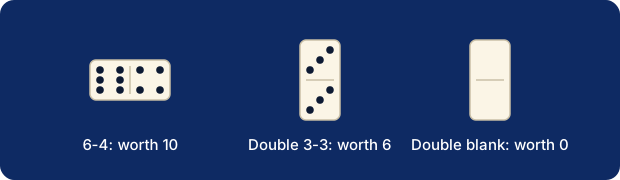
Sets are named after their highest double. Each set has exactly one tile for every pair of numbers:
| Set | Highest tile | Tiles | Total pips | Usually used for |
|---|---|---|---|---|
| Double six | 6-6 | 28 | 168 | Block, draw, muggins, partner games |
| Double nine | 9-9 | 55 | 495 | Chicken Foot, bigger groups |
| Double twelve | 12-12 | 91 | 1,092 | Mexican Train |
If you are buying one set, buy a double six. It plays every classic game for two to four people. The bigger sets are for the train-style games and groups of five or more.
Shuffling: the boneyard
Turn all the tiles face down and mix them around the table with flat hands. Players call this the shuffle, or "washing" the tiles. The face-down pile you draw from is the boneyard (also called the stock).
Who goes first
Tables pick the first player in a few ways:
- Everyone draws one tile, and the player with the heaviest tile (the most pips) goes first. The tiles go back and are shuffled again.
- The player holding the highest double, usually the 6-6, plays it as the first tile.
- In partner dominoes, whoever holds the 6-6 starts the first hand, and the winner of each hand starts the next.
After the first hand, many tables let the winner of the last hand lead, and others pass the lead to the left. Both are fine. Play usually moves clockwise, though many Caribbean tables play counterclockwise.
Dealing the tiles
Each player draws their hand from the boneyard and stands the tiles on edge so the others can't see them. With a double-six set, these hand sizes are the most common:
| Players | Tiles each | Left in the boneyard |
|---|---|---|
| 2 | 7 | 14 |
| 3 | 5 | 13 |
| 4 (each for themselves) | 5 | 8 |
| 4 (two teams of two) | 7 | 0 |
Some tables deal 7 tiles each to three or four players as well. That is a normal house rule; the boneyard is just smaller.
Setting down the first tile
The first tile played is called the set or the down. Whoever goes first places any tile from their hand face up in the middle of the table, unless your table's rule says the first tile must be the highest double. From then on, play goes around the table one turn at a time.
Matching tiles
On your turn, play one tile from your hand onto one of the two open ends of the line. The touching halves must match: a 5 goes against a 5, a blank against a blank. Then the next player takes their turn. The line, sometimes called the layout or the line of play, grows in both directions and is allowed to turn corners when it runs out of table.
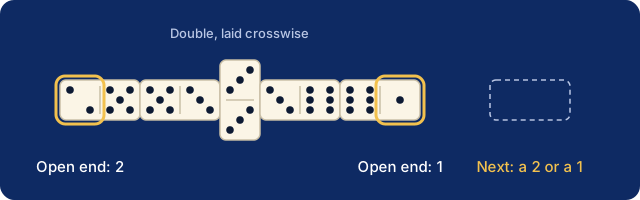
A good habit for beginners: before you play, look at both ends and every tile in your hand. You often have a choice, and the best move is usually the one that keeps a number you hold plenty of at an open end.
Doubles and spinners
A double is traditionally played crosswise, across the line, which makes it easy to spot. In the basic block and draw games, a double is just another tile with two ends: the line carries on from its far side with the same number.
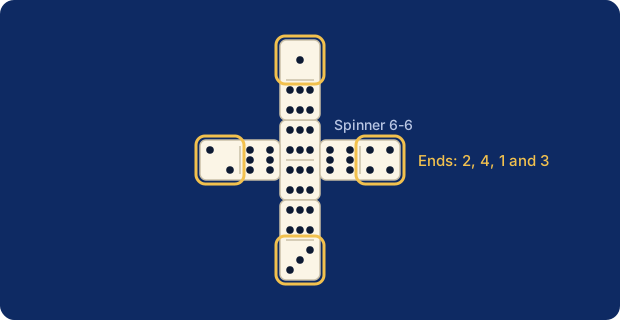
Some games give doubles extra power. In those games the first double played becomes a spinner, and tiles can be added to all four of its sides, so the layout grows into a cross with four open ends instead of two. Sniff and some versions of All Fives play this way, and Chicken Foot and Mexican Train build their whole layout around a starting double. If your table plays spinners, agree whether it is only the first double or every double.
Block or draw: when you can't play
What happens when you have no tile that matches either end is the main difference between the two basic games.
- Block game. You can't play, so you pass, and the turn moves on. Nobody draws from the boneyard; those tiles stay out of play for the whole hand. Partner dominoes is a block game, with all 28 tiles dealt.
- Draw game. You draw from the boneyard until you get a tile that fits, and you play it. If the boneyard is empty, you pass. Some tables leave the last two tiles in the boneyard and never draw them, which keeps the draw game from turning into a scramble.
The block game rewards memory: tracking which numbers each player has passed on tells you what they are missing. The draw game is friendlier for beginners, because you are never stuck for long.
Going out
When you play your last tile, you have dominoed (or gone out), and the hand ends at once. Many players announce it by saying "domino" as they lay it down. The player who goes out wins the hand.
Blocked games
Sometimes nobody can play: every open end shows a number that nobody holds, and there is nothing left to draw. The hand is blocked (a tranque in Spanish). Everyone turns their tiles over and counts their pips. The player, or team, with the lowest count wins the hand.
If two players tie for the lowest count, there is no standard answer. Common choices are that nobody scores and the hand is replayed, or that the win goes to a named player, such as the one who did not cause the block.
Scoring basics
In the classic games, the winner of a hand scores the pips left in the losers' hands. In a two-player block game where Ana goes out, Ben turns over his tiles and Ana scores them:
| Hand ends with | Ana's tiles | Ben's tiles | Ana scores |
|---|---|---|---|
| Ana dominoes | none (0) | 6-5, 4-2 (17) | 17 |
| Blocked, Ana has fewer | 3-1, 2-0 (6) | 6-6, 5-1 (18) | 18, or 12 if your table scores the difference |
In the blocked hand, most tables give Ana all of Ben's 18. Some subtract the winner's own count, and Ana scores 18 − 6 = 12. Both are traditional; pick one.
Hands add up to a game. Two players and partner teams usually play to 100, 150 or 200. Some three- and four-player tables play to 61 so they can keep score on a cribbage board. Our guide to scoring dominoes works through full examples, and the printable domino score sheet has columns for teams and for individual players.
Popular domino games
Once you know matching, blocking and counting, you can play almost any domino game. These are the ones you are most likely to meet.
Block dominoes
The plainest game: 2 to 4 players with a double-six set, no drawing, pass when you can't play. It is the best game for learning. See the full block dominoes rules.
Draw dominoes
Block dominoes with one change: when you can't play, you draw from the boneyard until you can. This is the game most families play at home.
Muggins (All Fives)
A draw game where you also score during the hand. After each play, add up the pips on the open ends; if the total is a multiple of five (5, 10, 15, 20), you score it on the spot. Read the muggins rules.
Mexican Train
A party game for 2 to 8 players with a double-twelve set. Everyone builds their own train from a central double, plus a shared Mexican Train anyone can use. The game runs 13 rounds, and points left in your hand count against you, so the lowest total wins. Read the Mexican Train rules and scoring.
Chicken Foot
Another lowest-score game, usually played with a double-nine set. Every double has to be covered by three tiles fanned out like a chicken's foot before anyone can play anywhere else. Read the Chicken Foot rules.
Partner dominoes
The game played across the Caribbean and Latin America: four players in two teams, partners facing each other, 7 tiles each and no boneyard. It is the block game with a team twist, usually played to 100, 150 or 200. Our Spanish guide covers dominó por parejas in detail.
Capicú
Not a separate game but a celebrated finish in partner dominoes: going out with a tile that fits either open end. Most tables that play it pay a 25-point bonus. Read what counts as a capicú.
A quick checklist before you play
- Which set, and how many tiles each?
- Block or draw? If draw, do the last two tiles stay in the boneyard?
- Who goes first, and who leads the next hand?
- Does the winner score only the opponents' pips, or every other hand?
- How is a blocked hand settled, and what happens on a tie?
- What target ends the game: 100, 150, 200 or something else?
Settle those six questions and you will spend the evening playing dominoes instead of arguing about them.
FAQ
How many dominoes does each player get?
With a double-six set, two players usually take 7 tiles each and three or four players take 5 each. In partner dominoes, four players take 7 each and all 28 tiles are dealt. Mexican Train and Chicken Foot use bigger sets and their own hand sizes.
What is the boneyard in dominoes?
The boneyard is the pile of face-down tiles left after the deal. In draw games, a player who can't play draws from it. In block games the boneyard is never touched during the hand.
What happens when nobody can play?
The game is blocked. Every player counts the pips left in their hand, and the lowest count wins the hand. Most tables give the winner the other players' pips, and some score only the difference.
Do you have to play a tile if you can?
In most rule sets, yes: you may only pass or draw when you have no tile that fits. A few draw-game tables let you draw even when you could play, so ask before the first hand.
What is the difference between block and draw dominoes?
In block dominoes you pass when you can't play. In draw dominoes you draw from the boneyard until you find a tile that fits, and you only pass once the boneyard is empty.
More domino guides
-
 Block dominoesBlock Dominoes Rules: How to Play and ScoreBlock dominoes rules: a double-six set, 7 or 5 tiles each, pass when you can't play, and the winner scores the pips left in the other hands. With examples.
-
 Chicken FootChicken Foot Dominoes Rules: How to Play and ScoreHow to play Chicken Foot dominoes: the double-nine set, the deal, the starting double, chicken feet on every double, the double blank at 50, and scoring.