 Domino Score
Block dominoes
Block Dominoes Rules: How to Play and Score
Block dominoes rules: a double-six set, 7 or 5 tiles each, pass when you can't play, and the winner scores the pips left in the other hands. With examples.
The block game is dominoes at its plainest, and the best way to learn. There is no drawing: you play the tiles you were dealt, and when you can't play, you pass. The first player to empty their hand wins and scores what everyone else is still holding. Every other domino game is a variation on this one. For the basics of the set and matching tiles, see how to play dominoes.
Setup
- Set: a double-six set, 28 tiles.
- Players: 2 to 4, each for themselves, or four as two teams of two.
- Deal: shuffle face down. Two players take 7 tiles each. Three or four players usually take 5 each, though plenty of tables deal 7. In the four-player team game all 28 tiles are dealt, 7 each.
The tiles not dealt stay face down and out of play for the whole hand. Nobody draws them.
Who goes first
For the first hand, players often draw a tile each and the heaviest one leads; other tables have the holder of the 6-6 play it first. After that, the lead either passes to the left or goes to the winner of the last hand.
Playing
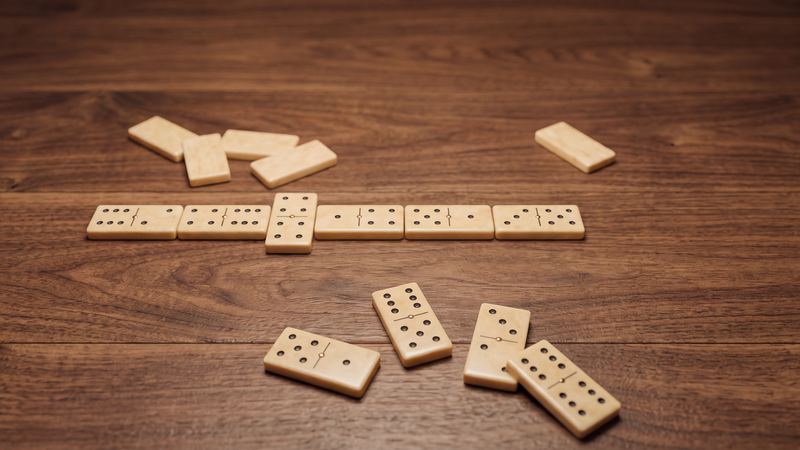
On your turn, play one tile that matches an open end of the line. Doubles are laid crosswise and work like any other tile: the line continues from the far side. There are only ever two open ends.
If no tile in your hand fits, you say "pass" and the turn moves on. Passing gives information away: everyone now knows you hold neither of the numbers showing. Good block players track every pass.
How a hand ends
- Domino. A player plays their last tile and wins the hand.
- Block. Nobody can play. Everyone counts the pips in their hand, and the lowest count wins the hand. If the lowest counts tie, most tables score nothing and play the next hand.
Scoring
The winner scores the pips left in the other players' hands. Here is a three-player hand where Ana goes out:
| Player | Tiles left | Pips |
|---|---|---|
| Ana | none (went out) | 0 |
| Ben | 6-3, 2-2 | 13 |
| Cara | 5-4 | 9 |
Ana scores 13 + 9 = 22.
In a blocked hand, the lowest hand wins and scores the others. If Ana is stuck with 4-1 (5 pips), Ben with 6-5 (11) and Cara with 3-3 and 2-0 (8), Ana wins with 5 and scores 11 + 8 = 19. Some tables subtract the winner's own count, which makes it 19 − 5 = 14. Agree before you play.
Playing to a target
Hands add up until someone reaches the target. Two players and teams usually play to 100; three- and four-player tables often play to 61, a cribbage-board total. Here is a two-player game to 100:
| Hand | Winner | Points | Ana | Ben |
|---|---|---|---|---|
| 1 | Ana | 22 | 22 | 0 |
| 2 | Ben | 15 | 22 | 15 |
| 3 | Ana | 31 | 53 | 15 |
| 4 | Ben | 27 | 53 | 42 |
| 5 | Ana | 19 | 72 | 42 |
| 6 | Ben | 40 | 72 | 82 |
| 7 | Ana | 30 | 102 | 82 |
Ana passes 100 in hand 7 and wins, 102 to 82. Our guide to scoring dominoes covers the variants, and the free domino score sheet has room for two teams or four players.
Block vs draw
The draw game uses the same rules with one change: when you can't play, you draw from the boneyard until you can. The block game is tighter and more strategic because every hand is fixed from the deal. The draw game is gentler for children and new players.
FAQ
What is the difference between block and draw dominoes?
In block dominoes you pass when you can't play and the leftover tiles are never used. In draw dominoes you draw from the boneyard until you find a tile that fits.
How many tiles does each player get in block dominoes?
With a double-six set, two players take 7 each. Three or four players usually take 5 each, and four players in teams take 7 each, so all 28 tiles are dealt.
What happens if a block dominoes game ties?
If a blocked hand leaves two players tied for the lowest count, most tables score nothing for that hand. Agree on it before you play, because some tables give the hand to a set player instead.
More domino guides
-
 Dominoes rulesHow to Play Dominoes: Rules for BeginnersHow to play dominoes, step by step: the set, shuffling, the deal, matching tiles, doubles, block vs draw, going out, blocked games and scoring.
-
Chicken FootChicken Foot Dominoes Rules: How to Play and ScoreHow to play Chicken Foot dominoes: the double-nine set, the deal, the starting double, chicken feet on every double, the double blank at 50, and scoring.